Don't Buy the B8 Oled Until You Read This Full Analysis
The transition from traditional LED-backlit LCD panels to Organic Light Emitting Diode (OLED) technology has been one of the most significant shifts in home entertainment over the last decade. Within this space, the entry-level OLED series often represents the most enticing proposition for the average consumer—a chance to own the "perfect blacks" and infinite contrast associated with the technology without the eye-watering price tag of a flagship model. The B8 OLED has long stood as that gateway drug for home theater enthusiasts. However, investing in a display that serves as the centerpiece of a living room for five to ten years requires more than just a passing glance at a spec sheet. This analysis dives deep into the architecture, performance, and long-term viability of the B8 to determine if it truly holds its value in a rapidly evolving market.
Television buyers typically prioritize a few core metrics: brightness for daytime viewing, motion handling for sports, input lag for gaming, and color accuracy for cinematic experiences. The B8 attempts to balance these needs while operating on a slightly more conservative internal processor than its more expensive siblings. While the hardware remains impressive, the nuances of its performance under different lighting conditions and content types are where the real story lies. Before committing your budget to this specific model, it is essential to understand where the technology excels and where the limitations of an entry-tier OLED might lead to buyer's remorse.
Hardware Architecture and the Alpha 7 Processor
The most critical distinction of the B8 OLED compared to other models in its generation is the underlying silicon. While the higher-tier models utilize the Alpha 9 Intelligent Processor, the B8 is equipped with the Alpha 7. This is not merely a branding exercise; the processor dictates how the TV handles noise reduction, sharpness, and high-frame-rate content. The Alpha 7 lacks some of the quad-step noise reduction capabilities found in higher models, which means that when viewing lower-bitrate content—such as standard definition cable TV or older streaming titles—you may notice more digital artifacts or banding in dark gradients.
Despite the lower-tier processing, the panel itself is a marvel of engineering. Because OLEDs are self-emissive, each of the roughly 8.3 million pixels can turn off completely. This creates a level of immersion that is physically impossible for even the best local-dimming LED TVs to replicate. In a dark room, the black bars at the top and bottom of a wide-screen movie disappear into the bezel, ensuring that your focus remains entirely on the director's intent. This architectural advantage is the primary reason the B8 remains a competitive option for movie lovers who prefer a darkened "cinema" environment.
Visual Performance and HDR Dynamics
High Dynamic Range (HDR) is the yardstick by which modern televisions are measured. The B8 supports the most critical formats: HDR10, HLG, and Dolby Vision. Dolby Vision, in particular, uses dynamic metadata to adjust the brightness and color of every scene, ensuring that the TV isn't just applying one "guess" to the entire film. On the B8, HDR highlights—like the sun reflecting off water or a flashlight in a dark hallway—reach impressive peak brightness levels, although they fall short of what the newest "high-peak" OLEDs or QLEDs can achieve.
The nuance of OLED HDR is found in "specular highlights." Because there is no backlight bleed (blooming), a bright white star can sit next to a pitch-black void of space without any hazy glow around it. This precision gives the image a "pop" that exceeds what the raw brightness numbers might suggest. However, shoppers should be aware that the B8 employs an Aggressive Auto Brightness Limiter (ABL). If you are watching a scene with a lot of white—such as a hockey game or a snowy landscape—the TV will automatically dim the entire screen to protect the panel and manage power. For users in very bright, sun-drenched rooms, this characteristic can be a drawback compared to traditional LED TVs that can maintain high brightness across the entire screen surface.
Detailed Feature Analysis
The B8 was designed to be a versatile display, but versatility is often defined by the specific software features and connectivity options available to the user. From a smart platform perspective, the inclusion of the webOS interface remains a high point. It is widely considered one of the most intuitive TV interfaces, utilizing a "Magic Remote" that functions like a computer mouse. This makes navigating through streaming apps like Netflix, YouTube, and Disney+ significantly faster than using standard d-pad remotes.
For gamers, the B8 presents a fascinating case study. It offers incredibly low input lag, often measuring under 22ms in Game Mode, which is excellent for competitive play. However, because it belongs to an older generation of hardware, it lacks most HDMI 2.1 features such as Variable Refresh Rate (VRR) or 4K at 120Hz. For a casual gamer using a Nintendo Switch or a standard PlayStation 4, this is irrelevant. However, if you have a modern gaming PC or a next-generation console and want to take advantage of high-refresh-rate gaming, the B8 acts as a bottleneck that will prevent you from seeing the full potential of your hardware.
Discover deals on TVs & Home Theater — updated daily.
View Offers →Reflections and Viewing Angles
One of the most praised aspects of OLED technology is the viewing angle. Traditional LCD panels often suffer from "gamma shift" or fading colors when you sit off to the side. The B8 maintains near-perfect color and contrast even at extreme angles. This makes it an ideal choice for wide living rooms where family members might be sitting in chairs placed at 45-degree angles from the screen. Whether you are directly in front or sitting on the far end of the sofa, the image remains consistent.
Regarding reflections, the B8 features a glossy anti-reflective coating. This coating is highly effective at deeping blacks by preventing ambient light from washing out the screen, but it does struggle with direct light sources. If you have a large window directly opposite the TV, you will see a defined reflection of that window during dark scenes. While the screen is bright enough to overcome mild glare, it is fundamentally designed for controlled lighting environments.
Pros and Cons
- Unmatched Contrast: Perfect black levels provide an infinite contrast ratio, making it superior to any LED for dark-room viewing.
- Wide Viewing Angles: Colors and brightness remain accurate even when viewed from the side, perfect for large groups.
- Intuitive Smart Interface: webOS and the Magic Remote make navigation and app switching seamless and fast.
- Low Input Lag: Excellent response times for 60Hz gaming, ensuring that inputs feel snappy and immediate.
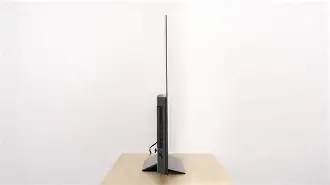
- Sophisticated Design: An incredibly thin profile that looks high-end and minimalist when wall-mounted or on a stand.
- Potential for Permanent Image Retention: Static elements like news tickers or HUDs can cause "burn-in" over very long periods of heavy use.
- Aggressive ABL: The screen dims significantly when displaying large, bright white areas, which can be distracting during sports.
- Lack of HDMI 2.1: No support for 4K/120Hz or VRR, limiting its long-term compatibility with high-end gaming hardware.
- Alpha 7 Processing: Slightly more digital noise and less effective upscaling compared to the Alpha 9 found in the C-series and above.
- Peak Brightness: While good for HDR, it cannot compete with top-tier QLEDs in extremely bright, sunlit rooms.
Model Comparison: B8 vs. Competitor Categories
To truly understand the B8's place in the ecosystem, it helps to compare it against the other types of displays a buyer might be considering. The following table outlines the general performance differences between the B8 OLED, a mid-range LED, and a high-end QLED (Quantum Dot LED).
| Feature | B8 OLED | Mid-Range LED | High-End QLED |
|---|---|---|---|
| Black Level | Perfect (0 nits) | Elevated / Grey | Deep (Local Dimming) |
| Peak Brightness | Moderate (~700 nits) | Low (~400 nits) | Very High (1500+ nits) |
| Viewing Angle | Excellent | Poor to Average | Average to Good |
| Motion Clarity | Instant Response | Blur-prone | Excellent |
| Risk of Burn-in | Yes (Low to Moderate) | None | None |
Buying Guide: Is the B8 Right for You?
Choosing the B8 over a newer model or a different technology depends entirely on your lifestyle and viewing habits. This guide breaks down the three most common types of TV buyers and how the B8 fits their needs.
The Cinema Enthusiast
If your primary use for a TV is watching 4K Blu-rays or high-quality streams in a dim or dark room, the B8 is a phenomenal choice. The Alpha 7 processor is more than capable of handling the high-bitrate data from a disc, and the infinite contrast ratio is the single most important factor for cinematic immersion. In this setting, the ABL issues are rarely noticed because films rarely stay at peak-white for extended periods. For "The Basement Cinema," the B8 offers 90% of the performance of flagship TVs at a fraction of the cost.
The Hardcore Gamer
If you are a gamer, the B8 requires a cautious approach. It is perfectly fine for the current generation of consoles and provides an "instantaneous" pixel response time that makes motion look much clearer than on an LED. However, the lack of Variable Refresh Rate (VRR) is a significant drawback for the future. VRR prevents screen tearing and stuttering when a game's frame rate fluctuates. If you plan on keeping your next TV for 5+ years and own a high-end console, you may want to look toward models with HDMI 2.1 support to avoid feeling "left behind" by the hardware.
The Casual Family Room User
For the average family room that sees a mix of morning news, afternoon sports, and evening Netflix, the B8 is a great all-rounder with one caveat: the room's lighting. If your television is placed directly opposite a large sliding glass door or in a sunroom, the B8's mirror-like finish and brightness limiter might frustrate you during the day. However, for "pre-peak" evening viewing, the gorgeous colors and wide viewing angles make it the best seat in the house for everyone, regardless of where they are sitting on the sectional.
Shop the latest TVs & Home Theater picks on Amazon.
See Deals →Mitigating the Risk of Burn-In
One cannot discuss the B8 without addressing the elephant in the room: burn-in. Because organic material degrades over time, particularly when pushed by high voltage (brightness), static images left on the screen for hours every day can leave a permanent ghost image. It is important to put this into perspective: for most users, this is not an issue. Modern OLEDs have "Pixel Refresher" cycles and "Screen Shift" technologies that mitigate this risk.
If you are the type of viewer who leaves a news channel on for eight hours a day where a bright red "BREAKING NEWS" banner sits in the same spot, or if you play one specific video game with a static HUD for several hours every day, the B8 might not be the best long-term investment. Conversely, if you watch varied content—movies, different shows, and different games—the risk of burn-in is statistically very low. Awareness and responsible use (such as utilizing a shorter "Auto-Off" timer) are usually enough to keep the panel in pristine condition for years.
The Evolution of Value
When the B8 was first released, it was positioned as the value-leader. In today's market, it occupies a unique space as a legacy OLED that still outperforms many brand-new mid-range LED TVs. The question of "value" is no longer about its original MSRP, but about what you are sacrificing by not opting for a C-series or a newer generation. You are sacrificing slightly better upscaling of low-quality video and the newest gaming features. For many, those sacrifices are worth the hundreds of dollars saved.
The build quality of the B8 also deserves a mention. It features a premium aesthetic with a brushed metal stand and a panel that is thinner than a smartphone at its top edge. This level of craftsmanship is often missing from modern "budget" TVs which tend to rely heavily on plastic components. Owning a B8 feels like owning a piece of high-end equipment, which adds to the pride of ownership for many home theater buffs.
Conclusion
The B8 OLED remains a powerful testament to the superiority of self-emissive display technology. Its ability to produce absolute black and vibrant, accurate colors makes it a formidable opponent for even the latest high-end LED displays. While the Alpha 7 processor isn't the absolute pinnacle of image processing, and the lack of HDMI 2.1 might give gamers pause, these are calculated trade-offs. For the buyer who values a pure cinematic experience above all else, the B8 delivers where it counts.
Ultimately, the decision to buy a B8 hinges on your environment and your priorities. If you can control the lighting in your room and your goal is to see movies exactly as the cinematographer intended, the B8 is a stunning piece of technology that will transform your viewing habits. It offers that rare combination of elite performance and sensible pricing, provided you understand its limitations regarding peak brightness and gaming features. By respecting the technology and using it within its intended parameters, the B8 can serve as the heart of a world-class home entertainment system for many years to follow.